SEOPress Event & Article Schema
Yoko Core cleans up the JSON-LD structured data SEOPress generates for events and posts, and adds the parts SEOPress's settings cannot express.
SEOPress's SEO → Schemas settings stay the source of truth for which field maps to what. This layer only tidies what SEOPress produced and fills the gaps. On a site that does not use the framework's event fields, SEOPress's output is left unchanged.
What it fixes
For an event, it:
- writes the dates in the format Google expects (
2030-06-01T17:00), with no timezone attached — Google uses the venue's own timezone, which is correct for an event held elsewhere; - turns the plain address line into a structured address (street, city, state, country), so Google can read the location;
- marks the event in person, virtual, or hybrid, from the Event Format assigned to it;
- for a virtual or hybrid event, adds the online location (the registration link);
- adds the ticket offer — the registration link and the public price;
- sets the event's link to the event's own page, not the venue website.
For a post, it lets the byline come from an Author field instead of the WordPress user (see Author byline).
Setting up an event
Three places, all in wp-admin:
| Where | What to set |
|---|---|
| SEO → Schemas → Event schema | Map Start/End Date and Time to event_start_date, event_start_time, event_end_date, event_end_time. Set Location URL to the venue website field, or None. |
| The event's Event Format | Assign In Person, Virtual, or Hybrid. This is what sets the attendance mode. Assign both In Person and Virtual to mark an event hybrid. |
| The event's fields | Fill the venue, city, state, country, registration link, and non-member price. Empty fields are simply left out of the schema. |
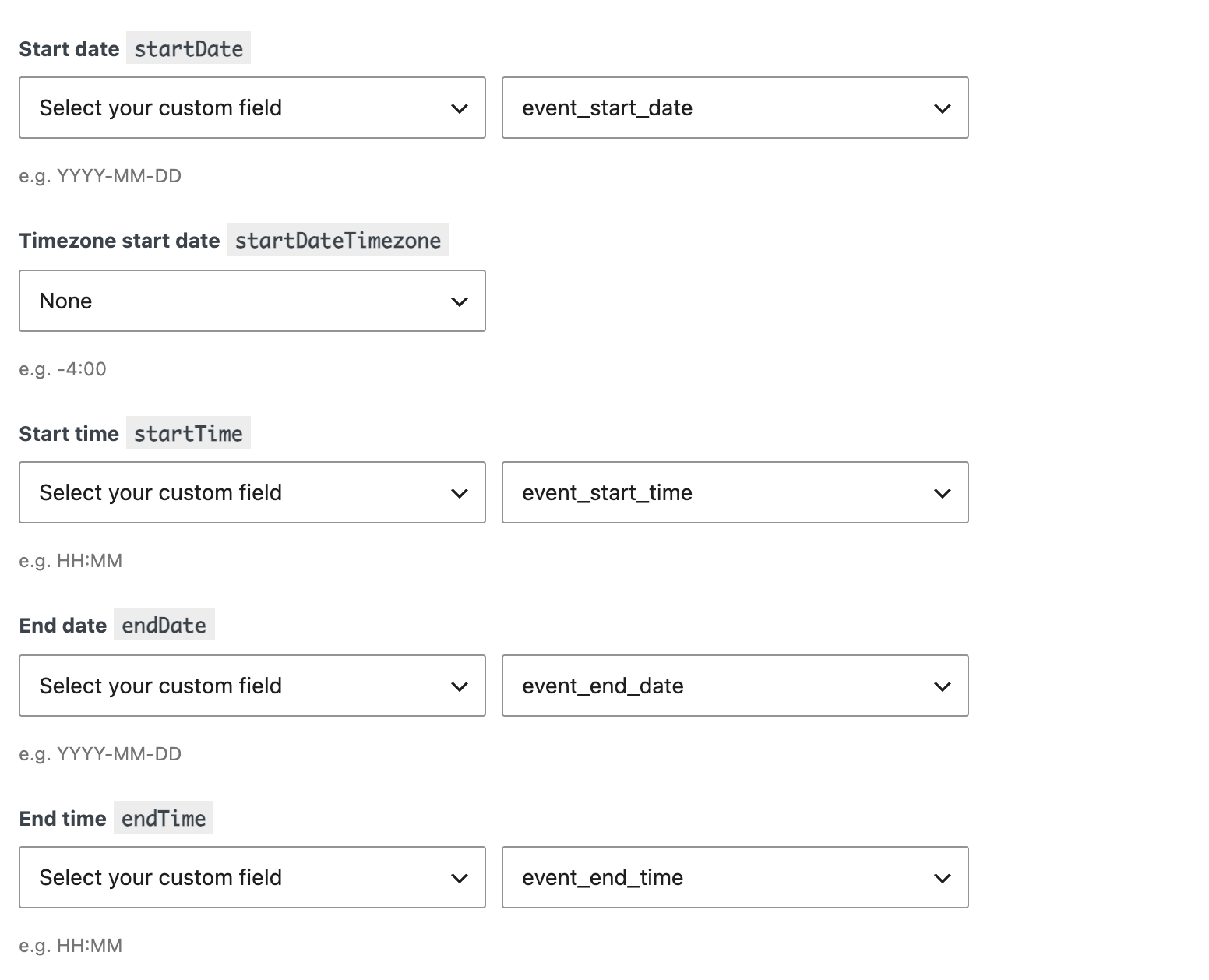
SEO → Schemas → the Event schema: Start and End Date and Time mapped to event_start_date, event_start_time, event_end_date, and event_end_time. The dates then come out correct; Yoko Core reformats them for Google.
The price shown is always the non-member price — Google wants the lowest price open to the general public, never the member rate.
Author byline
Some sites credit a post to a name typed into an Author field rather than to the WordPress user who published it. When that field holds a name, the schema author becomes that person. When it is empty, SEOPress's WordPress-user author stands. The field is the same in the block editor and the classic editor.
A site points both its on-page byline and this schema at the same field, so the two can never disagree.
Checking a post's schema
To see exactly what the filters produced for one post — without opening the page — run:
wp yoko schema show <post-id>
# BusinessEvent
{
    "@context": "http://schema.org",
    "@type": "BusinessEvent",
    "name": "First Example Event",
    "url": "https://example.com/event/first-example-event/",
    "startDate": "2030-06-01T17:00",
    "endDate": "2030-06-08T21:00",
    "location": {
        "@type": "Place",
        "name": "Bradbury Building",
        "address": {
            "@type": "PostalAddress",
            "streetAddress": "304 S Broadway St",
            "addressLocality": "Los Angeles",
            "addressRegion": "CA",
            "addressCountry": "USA"
        },
        "url": "https://example.com/venue"
    },
    "eventAttendanceMode": "https://schema.org/OfflineEventAttendanceMode",
    "offers": {
        "@type": "Offer",
        "url": "https://example.com/register",
        "price": 100,
        "priceCurrency": "USD"
    }
}
The command renders the schema fresh from the current data, so it may differ from a page still served from a full-page cache.
For developers
Two SEOPress filters are hooked, each of which passes only the built JSON-LD array (the current post comes from the queried object):
seopress_schemas_auto_event_json— the Event normalizer.seopress_schemas_auto_article_json— the Article author override.
Every meta key, taxonomy slug, and default is a framework default and filterable, so a site with different field names overrides the default rather than the behavior:
| Filter | Default | Purpose |
|---|---|---|
yoko_seopress_event_city_meta_key | event_location_event_city | City sub-field |
yoko_seopress_event_region_meta_key | event_location_event_state_or_province | State/region sub-field |
yoko_seopress_event_country_meta_key | event_location_event_country | Country sub-field |
yoko_seopress_event_registration_link_meta_key | registration_link | Registration link field |
yoko_seopress_event_price_meta_key | non-member_price | Public price field |
yoko_seopress_event_currency | USD | Offer currency |
yoko_seopress_event_format_taxonomy | event-format | Attendance-mode taxonomy |
yoko_seopress_attendance_mode_map | in-person → offline, virtual → online, hybrid → mixed | Maps Event Format term slugs to attendance modes |
yoko_seopress_event_organizer | SEOPress's organizer | The organizer; return null to remove it |
yoko_seopress_article_author_meta_key | post_author | The byline field |
yoko_seopress_article_author | { Person, name } | The resolved author; add a url or sameAs here |
URLs added to the schema are passed through esc_url_raw with an http/https
allowlist, so an unsafe value in a link field is dropped rather than emitted.